
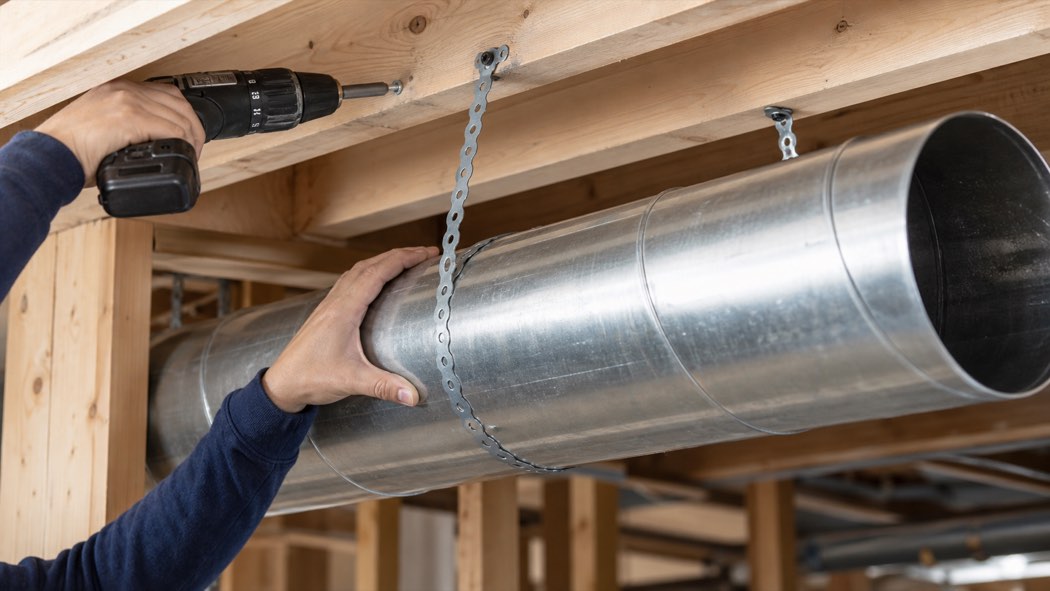
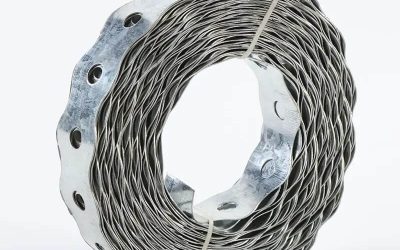
Perforated hanger strap is a small product, but it appears in many places on a jobsite. Installers use it to hold round duct, fix conduit, secure pipe, fasten cable sleeves, repair wooden posts, and keep light frames or equipment in position.
It is popular because it is simple. You can cut it to length, bend it around a pipe, choose the nearest hole, and fasten it with screws or bolts. That flexibility is exactly why contractors, maintenance workers, hardware stores, and DIY users keep it on hand.
But there is one question buyers often ask before using it:
How strong is perforated hanger strap?
The honest answer is that the strap alone does not decide the final strength. Gauge, width, material, screw type, fixing surface, support spacing, load direction, and environment all matter. A thick strap can still fail if it is fixed with the wrong screw. A good screw can still loosen if the wood is cracked. A galvanized strap may work well indoors but may not be suitable for long-term exposure in a wet or coastal area.
This guide explains how perforated hanger strap performs in real applications and how to choose the right specification more safely.
Perforated Hanger Strap Is a Fixing Product, Not a Universal Load-Rated Hanger
The first thing to understand is that general perforated hanger strap should not be treated as a universal load-rated suspension product.
It is very useful for fastening, positioning, supporting, and adjusting. But unless a specific product has been tested and rated as part of a complete assembly, it should not be described with one fixed load capacity.
In real use, the same roll can perform differently depending on whether it is:
- Wrapped around a pipe
- Screwed into wood
- Fixed to a metal frame
- Used to hang round duct
- Installed with one screw or multiple screws
- Used indoors or outdoors
- Exposed to vibration, moisture, or movement
For this reason, installers should look at the full connection, not only the metal strip.
Common Real-World Uses
Perforated hanger strap is used across several trades. The product may look the same, but the installation risk is different in each application.
Pipe and Conduit Fixing
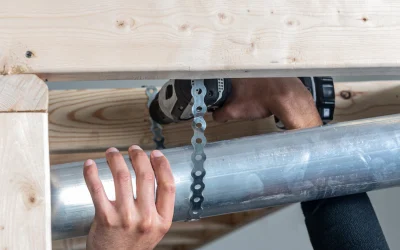
One common use is fixing pipe, conduit, or cable protection sleeves to walls, wooden structures, or metal frames.
The repeated holes make adjustment easy. If the pipe diameter does not match a standard clamp, the installer can wrap the strap around the pipe and fasten it through the nearest suitable hole.
This is useful for:
- Electrical conduit
- Cable sleeves
- Small pipe runs
- Light plumbing support
- Utility pipe fixing
- Frame-mounted pipe positioning
For this type of work, the main question is not only “Is the strap thick enough?” It is also:
- Is the pipe heavy?
- Is the pipe carrying water?
- Is the wall strong enough?
- Does the screw fit the hole properly?
- Is the strap holding the weight or only preventing movement?
- Will the pipe vibrate or move during use?
For light conduit or cable sleeve fixing, a lighter strap may be enough. For heavier pipe, users should consider a thicker gauge or a dedicated pipe clamp.
HVAC Duct Support
Perforated hanger strap is widely used in HVAC work, especially for round duct and light duct support. It is easy to cut, easy to adjust, and convenient when duct height needs small changes during installation.
For HVAC use, 3/4 inch galvanized steel hanger strap is often more practical than a narrow strip because it gives better contact and handling. 24 gauge is a common general-purpose choice. If the duct is larger, heavier, insulated, or installed in a commercial environment, some installers may prefer 22 gauge or 20 gauge for more rigidity.
However, gauge alone does not make an installation safe. Duct size, support distance, vibration, fastening method, and local installation requirements should all be checked.
A strap that works for a short, light duct section may not be suitable for a long or heavy duct run.
For more details about ductwork applications, read this HVAC hanger strap selection guide.
Wood Post, Fence and Outdoor Repair
Perforated metal strap is also used for repairs around wooden posts, fences, garden structures, and outdoor boards. In these cases, the strap is usually screwed directly into wood.
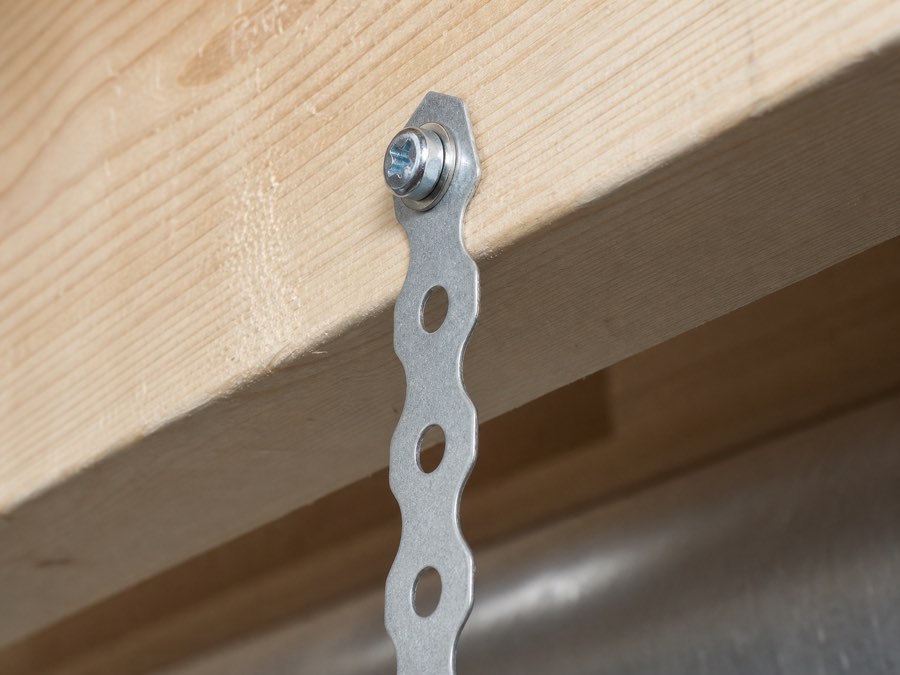
Here, the weakest point is often the wood or screw, not the strap.
Old wood may split. Wet wood may not hold screws well. Soft wood may loosen over time. If the screw is too small or installed too close to an edge, the connection can fail even when the strap itself is strong.
For outdoor repair, corrosion is another concern. Galvanized steel gives basic protection, but rain, soil contact, high humidity, or coastal air can shorten service life. For long-term outdoor use, buyers should confirm whether galvanized steel is enough or whether a different material or coating is needed.
If the strap may be used in humid or outdoor areas, this guide to galvanized vs stainless steel hanger strap can help buyers compare material options.
Rack, Frame and Light Equipment Securing
In warehouses, garages, workshops, and equipment areas, perforated strap is often used to hold small pipes, rods, flexible conduit, or light components against racks and frames.
In this type of application, the strap is usually not carrying a heavy hanging load. It is mainly stopping movement, keeping items organized, or holding parts in place.
This is where coated options can be useful. For example, PE coated strapping may be preferred when users want a covered surface or less direct metal contact.
Gauge Selection: 20, 22, 24 and 28 Gauge
Gauge is one of the first specifications buyers compare.
In general, a lower gauge number means a thicker and more rigid strap.
| Gauge | General Character | Typical Use Direction |
|---|---|---|
| 20 gauge | Heavier, more rigid | Stronger jobsite fixing, heavier support needs |
| 22 gauge | Medium-heavy | Contractor use, coated strap, stronger light support |
| 24 gauge | Balanced and common | HVAC, general fastening, retail and wholesale use |
| 28 gauge | Lighter, more flexible | DIY, light repair, temporary positioning |
A 20 gauge strap will usually feel stronger than a 24 gauge strap. A 24 gauge strap will usually feel stronger than a 28 gauge strap.
But thicker is not always the best choice. A thick strap is harder to bend around small pipes and harder to cut by hand. A thinner strap is easier to shape, but it should not be used where the support requirement is high.
For many general applications, 24 gauge is a balanced option. For stronger fixing, buyers can consider 22 gauge or 20 gauge. For light repair or retail DIY use, 28 gauge may be acceptable when the load is low and the installation is not critical.
Width Selection: 1/2 Inch vs 3/4 Inch
Your product range includes 1/2 inch and 3/4 inch perforated hanger strap.
A 1/2 inch strap is easier to fit in narrow spaces. It is useful for small conduit, cable sleeve fixing, light fastening, and compact repair work.
A 3/4 inch strap gives more contact area and is commonly used for HVAC duct support, pipe fixing, and general construction fastening.
For round duct, larger pipe, or applications where handling stability matters, 3/4 inch is usually the more practical choice. For small items or tight spaces, 1/2 inch can be easier to install.
Roll Length: 10 ft, 25 ft and 100 ft
Roll length should match the user type.
A 10 ft roll is good for small repairs, household use, retail shelves, and occasional fixing jobs.
A 25 ft roll is more suitable for contractors, hardware stores, maintenance work, and general installation.
A 100 ft roll is better for HVAC installers, larger jobsites, distributors, and users who need continuous supply.
For retailers, 10 ft and 25 ft rolls are easier for end users to buy. For contractors and wholesale buyers, 25 ft and 100 ft rolls are more efficient.
For distributors buying in larger quantities, this duct hanger strap wholesale buying guide explains roll length, packaging, and bulk order factors in more detail.
Material and Surface Options
Different surfaces are used for different needs.
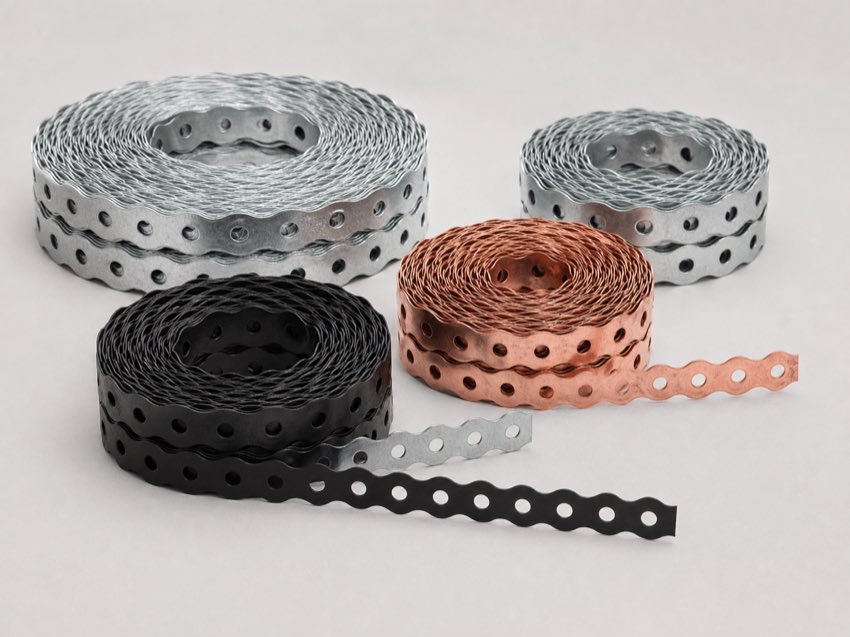
Galvanized Steel Strapping
Galvanized steel is the most common choice for perforated hanger strap. It is widely used for HVAC, plumbing, construction, general repair, and indoor fastening.
It offers a practical balance of cost, strength, and basic corrosion resistance.
Typical options include:
- 24 gauge, 10 ft, 3/4 inch galvanized steel strapping
- 24 gauge, 25 ft, 3/4 inch galvanized steel strapping
- 24 gauge, 100 ft, 3/4 inch galvanized steel strapping
- 20 gauge, 25 ft, 3/4 inch galvanized steel strapping
- 24 gauge, 25 ft, 1/2 inch galvanized steel strapping
Steel Strapping
Steel strapping can be used for general fastening and support applications, but buyers should confirm surface treatment and corrosion requirements before ordering.
If the product will be stored or used in a humid environment, surface protection should not be ignored.
PE Coated Strapping
PE coated strapping is useful when a coated surface is preferred. It may be used for cable sleeves, light pipe fixing, organizing work, or applications where users want less direct metal contact.
One example is 22 gauge, 10 ft, 1/2 inch PE coated strapping.
The coating does not automatically make the product suitable for every outdoor or heavy-duty application. Buyers still need to confirm the actual environment and use.
Copper Plated and Copper Strapping
Copper plated strapping and copper strapping are more specialized options. They may be selected for appearance, market demand, or specific application needs.
Examples include:
- 24 gauge, 10 ft, 3/4 inch copper plated strapping
- 24 gauge, 25 ft, 3/4 inch copper plated strapping
- 24 gauge, 25 ft, 3/4 inch copper strapping
Before choosing these options, buyers should confirm whether the requirement is appearance, conductivity, corrosion behavior, or a market-specific preference.
Fasteners Often Decide the Real Strength
Many installation problems happen at the fastening point.
A strong strap does not help much if the screw is too small, the anchor is weak, or the base material cannot hold the load.
Common problems include:
- Screw head too small for the hole
- Screw pulling through the strap
- Anchor loosening from the wall
- Wood splitting
- Thin sheet metal bending
- Strap fixed through only one weak point
- Vibration loosening the connection over time
For better installation, users should choose fasteners that match the base material. The screw or bolt head should cover the strap hole properly. Washers can help spread pressure around the hole, especially when the hole is larger than the screw head.
When the strap is used overhead or near moving equipment, the connection should be checked more carefully.
When Perforated Hanger Strap Works Well
Perforated hanger strap is a good solution when the job needs adjustability.
It works well for:
- HVAC duct positioning and support
- Light pipe fixing
- Conduit securing
- Cable sleeve holding
- General repair work
- Wood post or fence fixing
- Frame and rack organization
- Temporary positioning before final installation
Its biggest advantage is flexibility. A standard clamp fits only one size. Perforated strap can be bent and adjusted on site.
When It Should Not Be Used
Perforated hanger strap should not be used as a replacement for engineered support hardware.
Avoid using general hanger strap for:
- Lifting people
- Safety equipment
- Structural suspension
- Heavy overhead loads without approval
- High-vibration machinery
- Critical load-bearing systems
- Applications requiring certified load-rated hardware
- Severe outdoor or corrosive environments without material confirmation
If the application needs a certified load rating, use a tested hanger, clamp, bracket, or engineered support system.
How to Choose the Right Strap for Each Application
For HVAC duct support, start with 3/4 inch galvanized steel strap. 24 gauge is common, while 22 gauge or 20 gauge may be considered for more rigid support.
For pipe or conduit fixing, choose the width and gauge according to pipe size, pipe weight, and fastener type. 1/2 inch can work for smaller items, while 3/4 inch gives more contact area.
For wood post or fence repair, check the wood condition first. A thicker strap will not solve the problem if the screw cannot hold.
For rack, frame, or light equipment securing, PE coated strapping may be useful when surface protection or coated contact is preferred.
For DIY repair, 10 ft or 25 ft rolls are usually convenient.
For contractor or wholesale use, 25 ft and 100 ft rolls are more practical.
What Buyers Should Confirm Before Ordering
Before ordering, buyers should confirm the main perforated hanger strap specifications:
- Gauge: 20, 22, 24, 28 gauge, or custom
- Width: 1/2 inch, 3/4 inch, or custom
- Roll length: 10 ft, 25 ft, 100 ft, or custom
- Material or surface: galvanized steel, steel, PE coated, copper plated, copper
- Hole diameter
- Hole spacing
- Edge smoothness
- Roll tightness
- Packaging style
- Label or private label requirement
- Indoor or outdoor use
- Whether samples are needed
- Whether load-related test data is required
These details help avoid wrong specifications, poor installation fit, and customer complaints after delivery.
Sample Inquiry Template
For HVAC or contractor use:
We are looking for perforated hanger strap rolls for HVAC duct support and general pipe fixing. Please quote 3/4 inch galvanized steel strapping in 24 gauge, 25 ft and 100 ft roll lengths. We also want to compare 20 gauge and 22 gauge options. Please provide hole size, hole spacing, packaging, MOQ, lead time, and sample availability.
For retail or hardware store buyers:
We are interested in perforated hanger strap for retail sales. Please provide 1/2 inch and 3/4 inch options in 10 ft and 25 ft rolls, including galvanized steel, PE coated, and copper plated finishes. Please also share packaging and private label options.
FAQ
Can perforated hanger strap be used for HVAC duct support?
Yes. It is commonly used for HVAC duct support and adjustment. For this use, 3/4 inch galvanized steel strap is common. Gauge, fasteners, duct weight, and support spacing should all be considered.
Is 20 gauge hanger strap stronger than 24 gauge?
Generally, yes. 20 gauge is thicker and more rigid than 24 gauge. But the final installation strength also depends on screws, anchors, base material, and support spacing.
What is 28 gauge hanger strap used for?
28 gauge strap is lighter and easier to bend. It is better suited for light repair, DIY use, temporary positioning, or low-load fastening.
Should I choose 1/2 inch or 3/4 inch hanger strap?
Choose 1/2 inch for compact spaces and light fixing. Choose 3/4 inch when you need more contact area, especially for HVAC duct, pipe fixing, or general construction use.
Can galvanized hanger strap be used outdoors?
It can be used in some outdoor repair situations, but long-term exposure to rain, humidity, soil, or coastal air requires caution. Buyers should confirm whether the material and coating are suitable for the environment.
Does perforated hanger strap have a fixed load capacity?
Not always. Many general hanger strap rolls do not have one fixed load rating because performance depends on the full installation. If a rated load is required, ask for test data or use a certified support product.
Final Thoughts
Perforated hanger strap is useful because it adapts to real jobsite conditions. It can hold ductwork, secure conduit, fix pipe, organize cable sleeves, repair wooden structures, and fasten light components to frames.
But its strength is not decided by the strap alone. Gauge, width, material, fasteners, base surface, support spacing, load direction, and environment all affect the result.
For general HVAC and construction use, 3/4 inch galvanized steel strapping in 24 gauge is a practical starting point. For stronger fixing, 22 gauge or 20 gauge may be considered. For light repair and DIY use, 28 gauge or shorter rolls may be enough. For special surface needs, PE coated, copper plated, or copper strapping can be selected.
The safest approach is to match the strap to the real application, use the right fasteners, and avoid using general perforated strap where certified load-rated hardware is required.
If you need perforated hanger strap rolls in 20, 22, 24, or 28 gauge, view our galvanized steel hanger strap rolls or contact us for available widths, roll lengths, packaging, and sample options.

10 Best Fixing Bands in 2026: Rated and Compared
Introduction Fixing bands — all-round band, suspension band, perforated fixing band — are the Swiss army knife of mechanical and electrical installation: a thin galvanized steel strip with pre-punched holes that bends into brackets, wraps around pipe, hangs cable...
10 Best Steel Strapping Suppliers in 2026: Rated and Compared
Introduction Choosing among steel strapping suppliers in 2026 comes down to one honest question: are you buying a commodity band, a strapping system, or a private-label product? The answer decides which supplier is actually right for you — a global packaging house...
12 Best Metal Strap with Holes in 2026: Rated and Compared
Introduction A metal strap with holes — perforated hanger strap, plumber's tape, pipe strap — is one of the cheapest products on a truck and one of the easiest to buy wrong. The wrong gauge sags under a water line; the wrong coating rusts through in a crawl space; the...

Justin Wong
Hi, I’m Justin, the technical engineer of Jiangmen Masters. We’ve been running a factory in China that makes metal hanger strap for 16 years now, and the purpose of this article is to share the knowledge related to metal hanger strap from a Chinese supplier’s perspective.