
Direct answer: Metal strapping with holes is a perforated steel band — usually 3/4 in wide, 24 or 28 gauge, galvanized, with 3/16 in holes punched on 1 in centers — used to hang pipe, duct, and conduit from ceilings and joists. It supports roughly 185–375 lbf per strap depending on gauge (with a 3:1 safety factor), installs with screws and snips in minutes, and is sold in 10 ft bags at hardware stores or in 100 ft rolls and bulk coils from manufacturers.
What Is Metal Strapping with Holes?
This strapping is a continuous band of galvanized steel with evenly spaced punched holes running its full length. The holes are the entire point: a screw or nail passes through any of them, so the strap can be cut to length on site, wrapped around any pipe or duct diameter, and fastened without pre-drilling. You will also see it called perforated hanger strap, plumber’s tape, pipe strap, or band iron — same product, different trade names. The standard retail size is 3/4 in wide, 24 or 28 gauge, with 3/16 in holes on 1 in centers; wider 1 in and 1-1/4 in bands and heavier gauges cover bigger loads. As a manufacturer we produce it in every combination of those dimensions, and the differences between them are what decide whether an installation stays level for twenty years or sags in two.
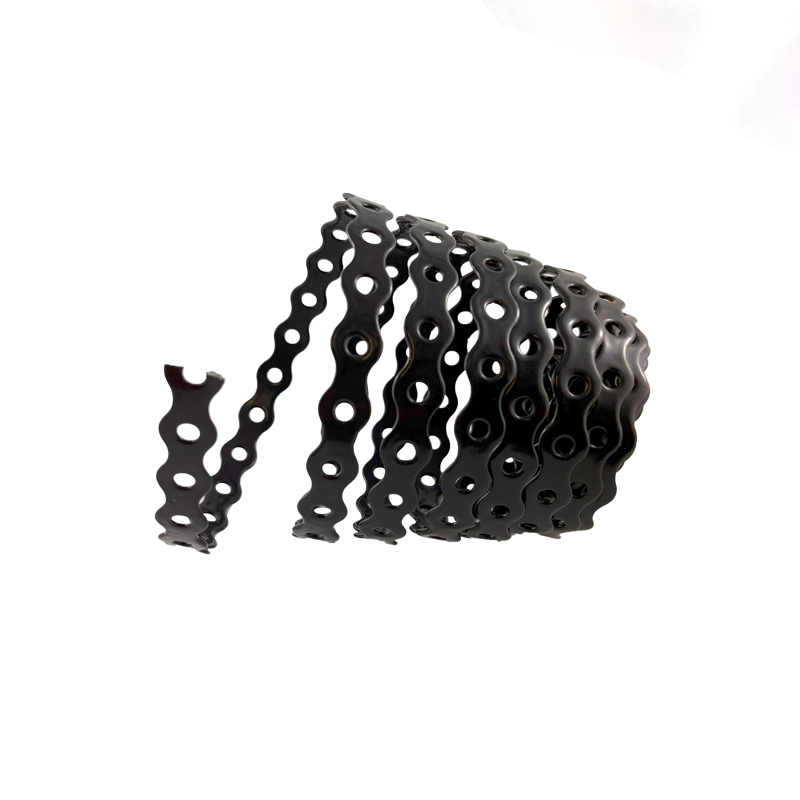
Heavy Duty Metal Strap with Holes vs. Standard: The Real Difference
Retail “heavy duty metal strap with holes” is usually a gauge or width upgrade, and the upgrade matters more than the word. A standard 28 gauge strap is 0.015 in thick; heavy-duty versions run 22 gauge (0.0299 in) to 12 gauge (0.105 in) for structural work. The math is simple: break strength equals cross-sectional area times tensile strength — about 50,000 psi for regular galvanized strap. A 3/4 in × 28 gauge strap has roughly 0.011 in² of steel and breaks near 560 lbf; a 3/4 in × 22 gauge strap has 0.0224 in² and breaks above 1,100 lbf — twice the capacity for a few cents more per foot. Our rule of thumb: if the load is a water line, conduit, or duct, 24–28 gauge is right; if the load is a person’s weight, machinery, or structure, buy the heavy gauge and engineer the connection.

How to Use Metal Straps with Holes
- Cut clean: use a strap cutter or sharp aviation snips, then deburr the cut end — a burr cuts hands and wiring, and a nicked edge is where vibration cracks start.
- Position the strap: wrap it under the pipe or duct and run both ends up to the support. Two fasteners per side is the minimum; the holes exist so you never drill.
- Match the fastener to the hole: a #8 or #10 pan-head screw fits a 3/16 in hole. An undersized screw concentrates stress at the hole edge and promotes tear-out, the most common field failure.
- Snug, don’t crush: tighten until the strap holds the pipe without deforming it; on copper, leave a hair of clearance for thermal movement.
- Protect cut ends: every site cut exposes bare steel. In wet locations, touch up with zinc-rich paint or step up to stainless from the start.
The load path is worth stating plainly: the strap carries the weight in tension, and the holes carry it to the fasteners — so the hole and the screw deserve as much attention as the gauge. For a deeper dive into capacity, read how strong is perforated hanger strap.
Where to Buy Metal Flat Straps with Holes
There are three realistic sources, and the right one depends on volume:
- Hardware stores and online retail: 10 ft bags and 25 ft rolls from plumbing and electrical aisles — right for one project, wrong per-foot price for a business. Expect $5–10 for 10 ft of 28 gauge.
- Trade suppliers and wholesalers: 100 ft rolls and bulk coils in 22–28 gauge, sold to contractors and distributors with better consistency and pricing at case quantity.
- Manufacturers: bulk coils, retail rolls, and private-label programs at container volume, with custom width, gauge, hole pattern, coating (G30–G90 or stainless), and edge type. This is where distributors and brands buy the product the retail shelves resell — and where the margin is. Request a quote with your annual volume on our contact page.
If you need the product in depth before ordering, see our perforated hanger strap page and the metal strap with holes product overview.
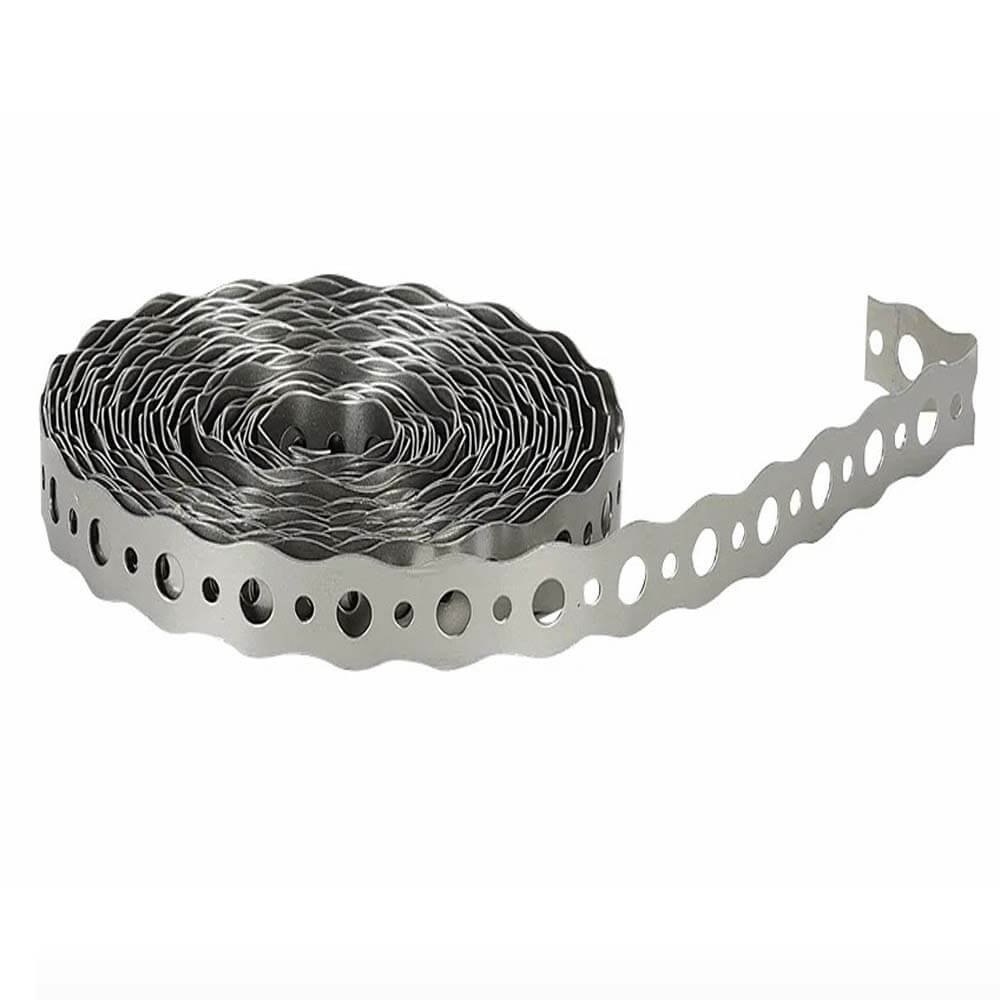
Metal Strap with Holes: Sizes and Specifications
| Property | Standard | Heavy Duty |
|---|---|---|
| Width | 1/2 in, 3/4 in, 1 in | 3/4 in – 1-1/4 in |
| Gauge | 24–28 (0.015–0.024 in) | 20–22 (0.030–0.036 in) |
| Hole pattern | 3/16 in on 1 in centers | 1/4 in on 2 in centers |
| Coating | galvanized G30–G60 | G90 or stainless |
| Break strength (3/4 in) | ≈ 560–900 lbf | ≈ 1,100 lbf and up |
| Typical packaging | 10 ft bag, 25 ft roll | 100 ft roll, bulk coil |
Complete dimensional tables are on our specification page.

Mistakes That Shorten a Strap’s Life
After sixteen years of watching these straps in service, the failures repeat in the same four places. Hole tear-out happens when a small screw in a big hole concentrates the load — use the largest fastener that fits and add washers. Rust at cut ends happens because galvanizing protects the surface, not the sheared edge — touch up or go stainless. Crushing happens when thin gauges are over-tightened — stop at snug. And sagging happens when 28 gauge is asked to hold a 24 gauge job — buy the gauge the load wants, not the gauge that was on sale. If you want the full checklist before a purchase, our metal strap with holes selection guide covers it end to end.
FAQ
- What is this strapping used for? Hanging and supporting pipe, duct, conduit, and cable from ceilings, joists, and walls, plus light bracing and bundling — anywhere a screw-through-the-hole connection works.
- How do you cut metal straps with holes? With a strap cutter or aviation snips, then deburr the cut end; the pre-punched holes mean the strap never needs drilling.
- What is the difference between metal strap with holes and metal strapping with holes? Nothing — singular and plural refer to the same perforated steel band product; suppliers use both phrasings in catalogs.
- How much weight can a metal strap with holes hold? Roughly 185–375 lbf as a safe working load for 3/4 in straps in 28–22 gauge at a 3:1 safety factor; heavy-duty gauges hold more than double that.
- Can metal strapping with holes be used outdoors? Yes, with G90 galvanized coating or stainless steel; G30 is for dry indoor use only.
Key Takeaways
- Galvanized perforated steel band, standard 3/4 in × 24–28 gauge with 3/16 in holes on 1 in centers.
- Heavy-duty means thicker gauge and wider band — 22 gauge holds about twice what 28 gauge holds.
- Installation is screws through existing holes: two fasteners per side, matched shank diameter, deburred cuts.
- Buy retail bags for one project, wholesale rolls for a business, and manufacturer-direct for distribution and private label.
Conclusion
This band looks like the simplest product on the shelf, and it is — until gauge, holes, and fasteners are chosen by guesswork. Match the gauge to the load, the screw to the hole, and the coating to the environment, and this cents-per-foot band will outlast the pipe it carries. For bulk orders, custom specifications, and private-label programs, download our product catalogs or send your RFQ through the contact page — we manufacture the galvanized substrate to ASTM A653 and answer every inquiry within 24 hours.