
Three support methods, one decision, and a surprising amount of disagreement in the field. Perforated strap is the cheapest and fastest way to hang light loads — and the material most often rejected on a commercial submittal. Clevis hangers are the default for suspended pipe. Trapeze assemblies take over as duct runs and pipe banks get larger.
Choosing wrong costs money twice: once when the inspector rejects the work, and again when it has to be torn out and redone.
The short version. Use perforated strap where the load is light, the environment is dry, and the governing specification permits it. Use clevis hangers for suspended pipe — especially insulated, hot, vibrating or adjustable runs. Use a trapeze when the duct is 36 inches or larger in its longest dimension, when several lines run parallel, or when the project specification requires rigid support. When a specification bans perforated strap outright, it does not matter how strong the strap is; the method is non-compliant before the first fastener goes in.
This guide is written for distributors, estimators, mechanical contractors and facility buyers who have to defend a support choice to someone with a clipboard. It is a buyer’s orientation, not a substitute for the governing code and the project specification. Verify every number against the edition your project cites.
1. The 30-second decision table
Start here. The rest of the article explains the reasoning and the exceptions.
| Decision factor | Perforated strap | Clevis hanger | Trapeze assembly |
|---|---|---|---|
| Best at | Light pipe, flexible duct, conduit, cable, HVAC accessories, general fixing | Suspended pipe of any size within the published rating | Large rectangular duct, parallel pipe/duct banks, heavy concentrated loads |
| Typical rating | Roughly 40–70 lb working load for retail 28–24 ga tape; 260 lb allowable for a 1″ × 22 ga engineered band hanger | About 200–1,430+ lb depending on pipe size, rod size and model | Engineered as a system; capacity set by the member, rod and anchors |
| Code risk | High on commercial duct specs; low for light plumbing, conduit and flexible duct | Low — the standard accepted method | Low — the default above 36″ |
| Install speed | Fastest | Medium | Slowest per point, but efficient across many parallel lines |
| Adjustability | Poor — you re-cut and re-fasten | Excellent — threaded rod and nuts | Good — shim and adjust at the rod |
| Material cost | Lowest | Medium | Highest per point |
| Biggest failure | Hole tear-out and over-tightening | Undersized rod or missing lock nut | Undersized angle or over-spanned rod |
Quick rule: if the word “commercial” appears anywhere in the project documents, assume perforated strap is a light-duty accessory — not a duct hanger — until the specification says otherwise.
2. What perforated strap is actually good at
Perforated strap — also sold as plumber’s tape, hanger strap, fixing band, Lochband or perforated banding — is a cold-rolled steel strip with evenly spaced punched holes. Common stock runs from about 1/2″ to 2″ wide, 20 to 28 gauge, with 3/16″ to 5/16″ holes on 1/2″ to 1″ centers. Finishes include pre-galvanized, hot-dip galvanized, stainless steel and PVC coating. For a full specification breakdown, see our guide to perforated hanger strap sizes, gauge, hole spacing and roll length.
Its advantages are real and should not be dismissed just because it is often misapplied:
- Infinite length adjustment. Cut anywhere, fasten through any hole. No threading, no fittings.
- Low profile. Fits tight ceiling voids where a clevis and rod will not.
- One material for many trades. A distributor can stock one SKU family and serve plumbing, electrical and HVAC light-duty needs.
- Fast. A single installer with snips and a screw gun can complete a run quickly.
- Good in tension and in wrapping. It performs best as a loop or a straight tension member, not as a beam.
2.1 Where perforated strap is the right answer
| Application | Typical width / gauge | Why it works | Watch out for |
|---|---|---|---|
| Flexible duct suspension | 1″ × 22–26 ga, or wider saddle | Light load, short spans, needs a wide bearing surface | IMC requires a saddle not less than 5.5″ wide for flexible duct — a narrow strap alone does not satisfy it |
| Copper, PEX and CPVC pipe up to about 1″ | 3/4″–1″ × 24–28 ga | Low weight, frequent support, easy to loop | Dissimilar-metal contact; use copper-plated or isolate |
| EMT conduit and cable bundles | 1/2″–3/4″ × 24–28 ga | Light, repetitive, fast | Sharp edges cutting cable jacket; deburr or use coated |
| HVAC accessories, sensors, small dampers | 3/4″–1″ × 24–26 ga | Very light point loads | Vibration loosening fasteners |
| General fixing and bracing of non-structural elements | 1″–2″ × 16–22 ga | Versatile, inexpensive | Seismic bracing requires engineered design — do not improvise |
| Formwork and temporary support | 3/4″–1″ × 20–24 ga | Disposable, quick | Not a permanent structural tie |
2.2 Where it is not
Perforated strap is a tension element with holes punched through it. Every hole is a stress concentration. It has almost no resistance to bending, it deforms duct if over-tightened, and it cannot be adjusted after installation without adding holes. That makes it a poor choice for:
- Rigid rectangular duct in commercial work, where most specifications require band hangers, trapeze or clevis-type support.
- Pipe larger than about 2″, insulated pipe, steam and high-temperature lines.
- Anything requiring slope adjustment, vibration isolation or seismic qualification.
- Lifting, fall protection, rigging or structural connections. It is not rated for any of these.
- Coastal, washdown or chemically aggressive environments unless stainless or a suitable coating is specified.
For a deeper treatment of strength and safe use, see how strong perforated hanger strap really is.
3. What codes and specifications actually say
This is the section that decides most arguments. There is no single national rule that says “perforated strap is banned.” The prohibition almost always comes from the project specification, not from the model code. That distinction matters, because a supplier who claims blanket code approval is overstating, and a contractor who assumes blanket prohibition is leaving money on the table.
3.1 The model code: IMC §603.10
The International Mechanical Code addresses duct support in §603.10 (“Supports”). In substance, it requires ducts to be supported at intervals not exceeding 12 feet and in accordance with SMACNA’s HVAC Duct Construction Standards — Metal and Flexible. It also requires flexible and other factory-made ducts to be supported on a saddle not less than 5.5 inches wide and installed per the manufacturer’s instructions.
Two practical consequences follow:
- 12 feet is a ceiling, not a target. Local amendments are often stricter. Some jurisdictions cap rectangular duct support at 10 feet. Always check the local amendment.
- The code points at SMACNA, not at a product. Compliance is judged against the SMACNA method and the project specification, which is why the same strap can be acceptable on one job and rejected on the next.
If your project is under the Uniform Mechanical Code rather than the IMC, note that the UMC reorganizes support requirements — in the 2021 edition they sit around §603.8, with flexible duct support at §603.8.2. Do not quote IMC section numbers on a UMC job.
3.2 SMACNA Chapter 5 and the terminology trap
SMACNA’s HVAC Duct Construction Standards (3rd edition) covers hangers and supports in Chapter 5. Table 5-1 gives minimum hanger sizes for rectangular duct; Table 5-2 covers round duct. The tables are organized by the duct’s half-perimeter (P/2) and by hanger spacing — typically 10, 8, 5 and 4 feet.
Here is the trap. When SMACNA says “strap hanger,” it means a metal band hanger — typically 1″ to 1-1/2″ wide and 16 to 22 gauge, attached with two fasteners or a bolt. It does not mean the 3/4″ × 28 ga perforated plumber’s tape sold in a 10-foot retail pack. The two products share a shape and nothing else. Many submittal rejections come from a contractor substituting retail tape for a specified band hanger and calling both “strap.”
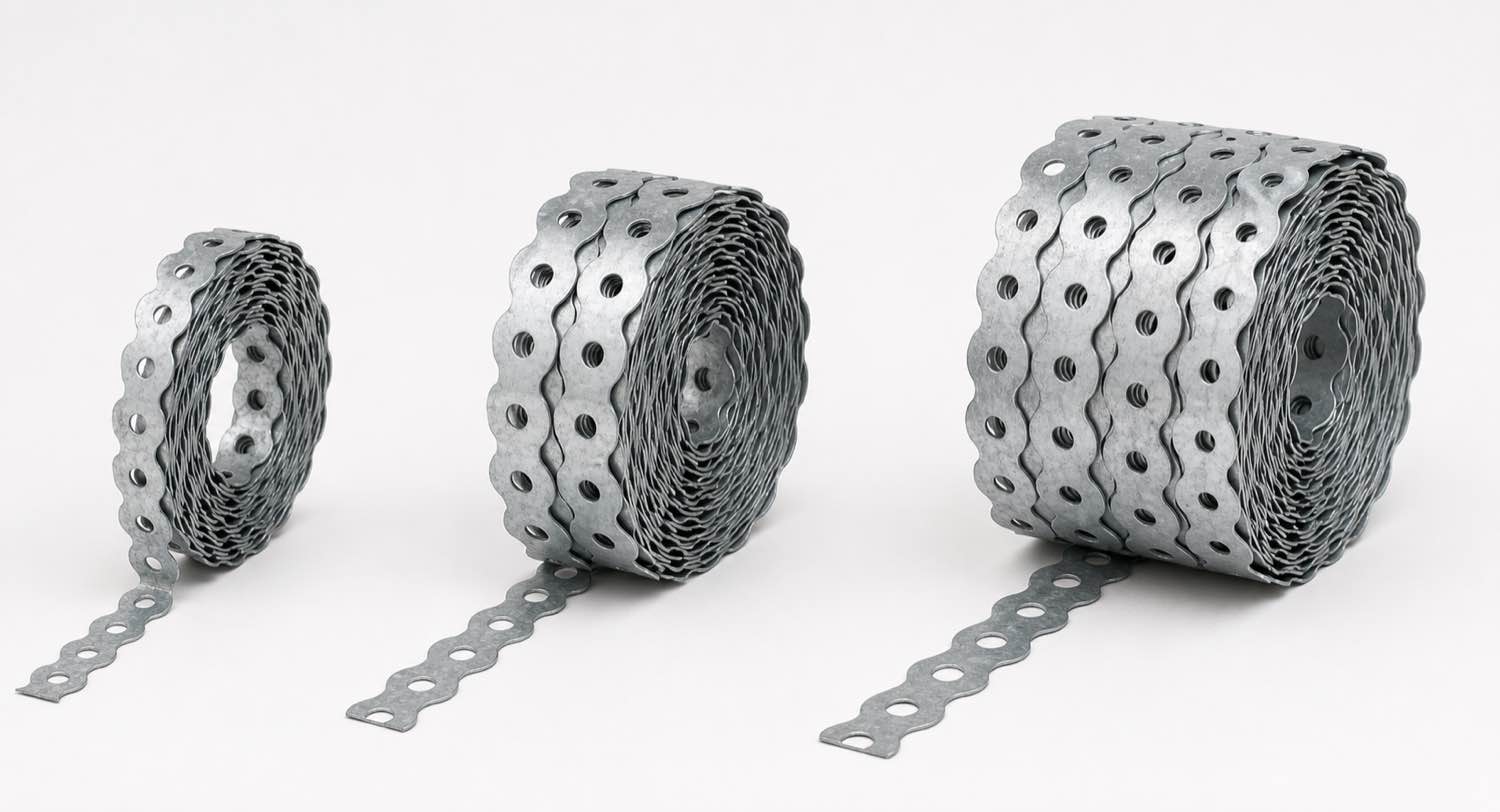
Width and gauge decide the method. Retail plumber’s tape and a specified band hanger are not interchangeable.
Representative values from Table 5-1, as reproduced in industry training material:
| Duct half-perimeter (P/2) | 10 ft spacing | 8 ft spacing | 5 ft spacing | 4 ft spacing |
|---|---|---|---|---|
| 72″ | 1″ × 18 ga | 1″ × 20 ga | 1″ × 22 ga | 1″ × 22 ga |
| 96″ | 1″ × 16 ga | 1″ × 18 ga | 1″ × 20 ga | 1″ × 22 ga |
| 120″ | 1-1/2″ × 16 ga | 1″ × 16 ga | 1″ × 18 ga | 1″ × 20 ga |
| 168″ | 1-1/2″ × 16 ga | 1-1/2″ × 16 ga | 1″ × 16 ga | 1″ × 18 ga |
| 192″ | Not given | 1-1/2″ × 16 ga | 1″ × 16 ga | 1″ × 16 ga |
| 193″ and up | Special analysis required | |||
Adapted from SMACNA SDCS Table 5-1 as reproduced in industry training material. Values are indicative; use the edition your specification cites.
The same source gives single-hanger allowable loads of about 260 lb for 1″ × 22 ga band hanger, rising to about 1,100 lb for 1-1/2″ × 16 ga, with the upper attachment limited to one-quarter of its failure load. That 4:1 relationship is the safety factor built into the method. It is also why a manufacturer’s “750 lb” tensile number and a retailer’s “70 lb” working load can both be described as “correct” — they are measuring different things. We cover that confusion in detail in our strength and safe-use guide.
Fastening rules matter as much as strap size. For lap joints, 1″ × 18, 20 and 22 ga strap commonly requires two #10 screws or one 1/4″ bolt; 1″ × 16 ga requires two 1/4″ fasteners; 1-1/2″ × 16 ga requires two 3/8″ fasteners, placed in series. A single screw through a single hole is not a hanger.
3.3 The project specification is the real gatekeeper
In commercial construction, the specification usually goes further than the code. Common clauses include:
- “Perforated strap or wire will not be acceptable as hanger material.”
- “Perforated strap iron (‘plumber’s tape’) shall not be used to support ducts.”
- “Support rectangular ducts up to 36 inches by strap-type hangers attached at not less than three places to not less than two duct surfaces in different planes, or by trapeze hangers. Support rectangular ducting 36 inches and larger with trapeze hangers.”
- “Hangers shall be spaced per SMACNA, maximum 10 feet on center.”
- “Provide hangers within 24 inches of each elbow and 48 inches of each branch intersection.”
Notice what these clauses do: they prohibit a material, define an attachment pattern, set a size threshold and tighten the spacing. Any one of them can decide your method before load capacity is even discussed.
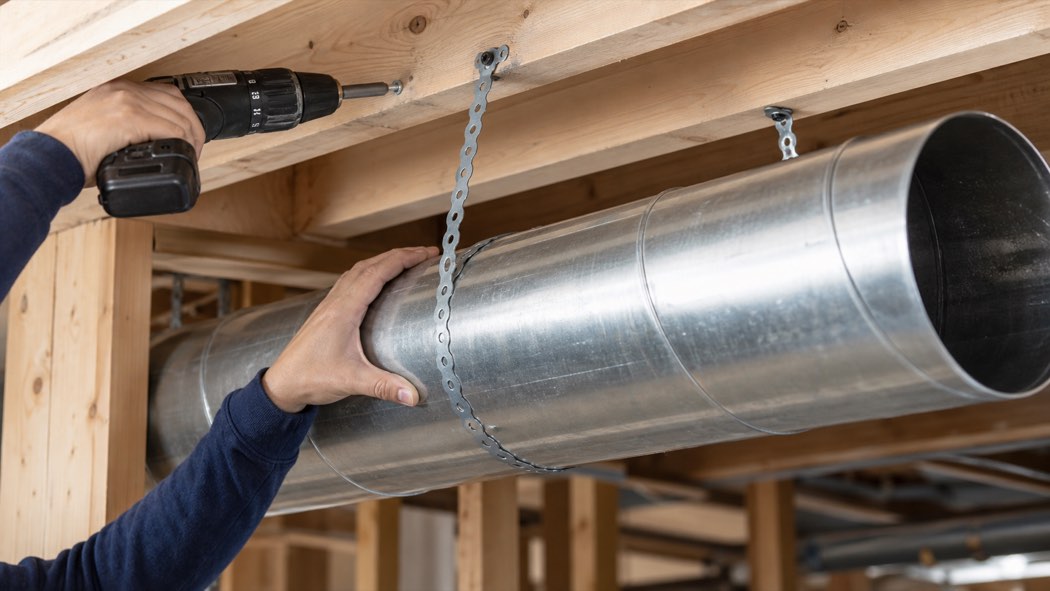
Duct support is judged against the specified method, not the product’s tensile rating.
| Governing document | What it controls | Typical effect on perforated strap | What to verify |
|---|---|---|---|
| IMC §603.10 (or local amendment) | Maximum spacing, SMACNA reference, flexible duct saddle | Silent on the product; sets the framework | Local amendment spacing (12 ft vs 10 ft) |
| UMC §603.8 (2021) | Support requirements under UMC | Silent on the product; different section numbering | Which code family the AHJ enforces |
| SMACNA SDCS Ch. 5, Tables 5-1/5-2 | Band/rod/angle size by P/2 and spacing | Expects metal band hangers, not retail tape | Edition cited; table row for your P/2 |
| Project specification (Division 23) | Materials, attachment pattern, size thresholds | Frequently prohibits perforated strap for duct | Explicit product bans and 36″ trapeze rule |
| Seismic restraint manual | Bracing intervals and hardware | Requires engineered bracing, not improvised strap | Lateral/longitudinal spacing and attachment details |
| Manufacturer instructions | Product ratings, fasteners, installation | Defines the working load you may rely on | Published working load, not tensile strength |
3.4 Round duct, vertical duct and seismic notes
A few numbers come up often enough to memorize, but always confirm them against the specification:
- Round duct: hanger spacing commonly tightens as duct area grows — around 8 ft up to 4 sq ft, 6 ft for 4.1–10 sq ft, and 4 ft above 10 sq ft in some specifications.
- Vertical duct: supported at each floor and at intervals not exceeding 16 ft.
- Seismic: SMACNA’s seismic guidance is commonly cited at lateral restraint not exceeding 40 ft on center and longitudinal not exceeding 80 ft, but the project’s geotechnical and seismic category govern.
4. Clevis hangers: when they are mandatory
A clevis hanger is an adjustable pipe hanger in which a U-shaped yoke carries the pipe and a threaded rod passes through the top. It is classified as a Type 1 hanger under MSS SP-58 (materials and manufacture) and selected under MSS SP-69 (application). It is the default suspended-pipe support in commercial mechanical work for good reasons: it adjusts, it does not crush insulation, it tolerates movement and it carries real load.
4.1 Why clevis wins on pipe
- Adjustability. Two nuts let you set elevation and slope precisely — essential on drainage and steam lines.
- Insulation protection. The yoke bears on the pipe or on a shield, not on a thin strap edge that compresses insulation and breaches the vapor barrier.
- Load range. Published ratings scale from a few hundred pounds to well over a ton.
- Code familiarity. Inspectors expect it; submittals sail through.
- Vibration and thermal movement. The rod-and-yoke arrangement tolerates movement better than a rigid strap loop.
4.2 Sizing and installation checks
Ratings vary by manufacturer, pipe size, rod diameter and material. Representative figures for common carbon-steel adjustable clevis hangers:
| Pipe size | Typical rod size | Representative max load | Notes |
|---|---|---|---|
| 1″ | 3/8″ | ~610 lb | Stainless versions may differ |
| 2″ | 3/8″–1/2″ | ~730 lb | Common HVAC/plumbing size |
| 4″ | 1/2″–5/8″ | ~1,430 lb | Confirm with manufacturer table |
| 5″ | 5/8″ | ~1,430 lb+ | Rod often governs before the yoke |
Indicative values from common manufacturer catalogs. Always use the published load table for the exact model and rod you are supplying.
Installation checks that catch most failures:
- Two nuts, always. One above and one below the hanger, tightened against each other. A single nut lets the hanger walk down the rod under vibration.
- Rod size matches the hanger rating. The weakest link sets capacity — usually the rod or the anchor, not the yoke.
- Anchor capacity checked. A 1,430 lb hanger on a 200 lb concrete insert is a 200 lb hanger.
- No pipe crushing. Use a shield or insulator on soft or insulated pipe.
- Correct material. Copper-plated or stainless for copper lines; galvanized for general service; confirm temperature limits for the finish.
4.3 When a specification effectively forces a clevis
Even if the code does not name clevis hangers, the specification often does. Treat clevis as mandatory when you see: insulated pipe over about 1-1/2″; steam, condensate or hot-water lines; pipe requiring slope; vibration-producing equipment connections; pipe 2″ and larger in most commercial specs; or any clause requiring “adjustable” or “MSS SP-58 Type 1” hangers.
5. Trapeze: the 36-inch threshold
A trapeze is a horizontal member — angle iron, strut channel or a formed strap — suspended by two or more rods, carrying one or more ducts or pipes. It is the standard answer when a single hanger cannot do the job or when the specification says so.
5.1 The rule that decides most duct jobs
A very common specification requirement is that rectangular duct 36 inches and larger in its longest dimension must be supported by trapeze hangers. Smaller rectangular duct may use strap-type hangers attached at three or more points across at least two duct surfaces in different planes. Some specifications use 60 inches instead of 36; some allow strap hangers up to 60 inches for light-duty work. The threshold is a specification choice, not a universal code number — but 36 inches is the most frequently encountered line in the documents you will actually bid against.
When you see a 36-inch threshold and a prohibition on perforated strap in the same section — which is common — the decision is already made. No amount of strap strength changes it.
5.2 Designing the trapeze
Trapeze design is a structural calculation, but the inputs are predictable:
- Load per rod = total supported weight (duct + insulation + contents + member) divided by the number of rods, with a safety factor.
- Member size from span and load. A commonly cited example: an 8-foot span with light duct calls for 2″ × 2″ × 1/8″ angle and 5/16″ rod. Longer spans or heavier loads move up quickly.
- Rod size from the load table, not from habit.
- Anchors rated for the rod load, including pull-out and shear.
- Lateral bracing where seismic or wind requirements apply.
Trapeze is also the efficient choice for parallel runs. One trapeze carrying a duct and two pipes can replace three separate hanger systems and often reduces total installed cost even though the material bill is higher.
6. Cost per support point: an honest model
Material price is the least useful number in this decision. What matters is installed cost per support point — material, fasteners, anchors, labor minutes and rework risk. The model below uses an index rather than invented dollar figures, so you can drop in your own quotes.
| Cost element | Perforated strap (single point) | Clevis hanger (single point) | Trapeze (two pipes + duct) |
|---|---|---|---|
| Support material | 100 (index) | ~180–260 | ~300–450 |
| Fasteners / anchors | 100 | ~130 | ~150 |
| Labor minutes | 100 | ~180 | ~250 per point, but covers 3 lines |
| Inspection / rework risk | High on commercial duct | Low | Low |
| Installed cost index | 100 | ~170 | ~130–160 per supported line |
| Best economic case | Light, short, dry, permitted | Insulated or adjustable pipe | Dense parallel runs, large duct |
Illustrative index model, not a price list. Labor and anchor costs vary widely by region and ceiling condition.
Two conclusions usually survive the numbers:
- Perforated strap is cheapest only when it is permitted. Once rework is priced in, a rejected run is the most expensive option on the job.
- Trapeze looks expensive per point and is often cheapest per supported line when three or more services run together.
7. Failure modes and inspection checklist
7.1 The six failures we see most
- Hole tear-out. The fastener bears on a thin web of steel between holes. Undersized washers, screws off-center or over-tightening start a tear that propagates under vibration. Fix: correct fastener, flat washer, do not over-torque.
- Over-tightening and duct deformation. A strap pulled tight around rectangular duct cups the sidewall and changes the duct’s shape and airflow. SMACNA-based guidance is explicit that hangers must not deform the duct.
- Undersized rod or anchor. The hanger is rated for 1,400 lb but hangs from a 3/8″ rod or a light concrete insert. Capacity is set by the weakest element.
- Galvanic corrosion. Copper strap on steel, or stainless fasteners in a galvanized strap in a wet environment. Fix: match materials or isolate.
- Insulation and vapor-barrier damage. A thin strap edge compresses insulation and breaks the vapor barrier, causing condensation and corrosion hidden from view.
- Missing lock nut. The hanger walks down the rod. Always two nuts.
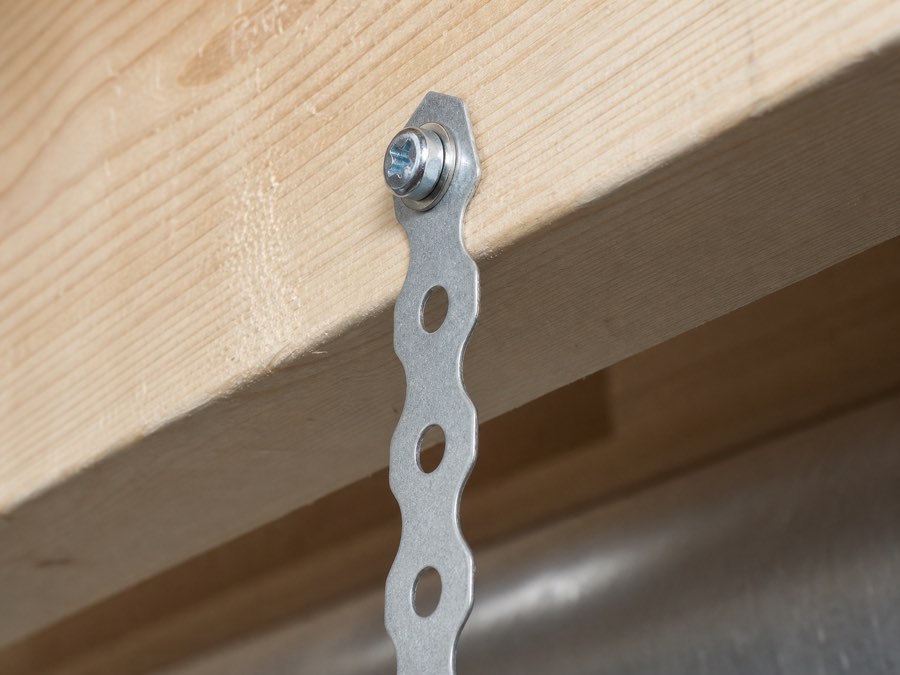
Hole tear-out and over-tightening are the two most common strap failures. The fastener bears on a thin web of steel.
7.2 Pre-inspection checklist
- ☐ Governing code family confirmed (IMC vs UMC) and local amendment checked.
- ☐ Project specification searched for the words “perforated,” “plumber’s tape,” “strap hanger” and “trapeze.”
- ☐ Duct size compared against the 36-inch (or specified) threshold.
- ☐ Band/rod/angle size read from the correct SMACNA table row for P/2 and spacing.
- ☐ Fastener count and size match the lap-joint rule (two #10 or one 1/4″ bolt, etc.).
- ☐ Anchor pull-out and shear capacity ≥ hanger load with safety factor.
- ☐ Flexible duct supported on a saddle at least 5.5″ wide.
- ☐ Hangers within the specified distance of elbows and branch intersections.
- ☐ Insulation and vapor barrier intact at every support.
- ☐ Two nuts on every threaded rod; no hanger bearing on a single nut.
- ☐ No duct deformation visible at any strap.
- ☐ Seismic bracing per the project’s restraint manual, not improvised.
8. A submittal-ready RFQ template
Most support disputes start with a vague inquiry. Send these fields and you will get a quote you can actually submit:
- Application: duct, pipe, conduit, cable tray or general fixing.
- Service and size: duct dimensions or pipe NPS, plus insulation thickness.
- Quantity: number of support points and lineal feet.
- Spacing: required on-center spacing from the specification.
- Governing spec: code edition and Division 23 section number.
- Method allowed: state whether perforated strap, band hanger, clevis or trapeze is permitted.
- Load per point: calculated or specified.
- Material and finish: pre-galvanized, hot-dip, stainless grade, PVC coated.
- Dimensions: width, gauge or actual thickness, hole diameter, hole pitch, roll or stick length.
- Fasteners and anchors: type, size, substrate.
- Environment: indoor, outdoor, coastal, washdown, temperature range.
- Submittal requirements: datasheet, load table, test report, certification, sample.
For packaging and distributor approval requirements, see our perforated hanger strap packaging checklist. For wholesale volumes and lead times, the HVAC duct hanger strap wholesale guide covers MOQ, coil lengths and shipping.
9. FAQ
Can perforated hanger strap be used to support ductwork?
Sometimes, but rarely in commercial work. The model code does not ban it outright; it defers to SMACNA and the project specification. Many commercial specifications explicitly prohibit perforated strap or plumber’s tape as duct hanger material and require band hangers or trapeze. For light residential flexible duct, a wide saddle and manufacturer-approved strap may be acceptable. Read the specification before you price the job.
Is perforated strap the same as plumber’s tape?
In retail use, yes — the terms overlap. In specification language, no. “Strap hanger” in SMACNA means a metal band hanger, typically 1″ to 1-1/2″ wide and 16 to 22 gauge, attached with two fasteners or a bolt. Retail plumber’s tape is often 3/4″ wide and 28 gauge. They look similar and are not interchangeable.
What is the difference between break strength and working load?
Break strength is the load at which the product fails in a tensile test. Working load is the load it may carry in service, after applying a safety factor and accounting for fasteners, holes and installation. A published 750 lb tensile figure and a 70 lb working load can describe the same product. Specify and inspect against the working load.
When must I use a clevis hanger?
When the specification requires MSS SP-58 Type 1 or “adjustable” hangers, when pipe is insulated or larger than about 2″, when slope must be set, or when the line carries steam, hot water or vibration. In practice, most commercial suspended pipe above 1-1/2″ is clevis-hung.
At what duct size do I need a trapeze hanger?
The most common specification threshold is 36 inches in the longest dimension, though some use 60 inches. Rectangular duct at or above the threshold must be supported by trapeze; smaller duct may use strap-type hangers attached at three or more points across two surfaces in different planes. Confirm the number in your Division 23 section.
How far apart should duct hangers be?
IMC §603.10 caps support intervals at 12 feet and defers to SMACNA. Many local amendments and specifications tighten this to 10 feet for rectangular duct, and round duct spacing often tightens with duct area — commonly 8, 6 or 4 feet. Hangers are also typically required within 24 inches of an elbow and 48 inches of a branch intersection.
Can perforated strap be used for pipe support?
Yes for light pipe — copper, PEX and CPVC up to about 1″ — where the specification permits it and the working load is respected. It is a poor choice for insulated pipe, larger diameters, hot lines or anything needing adjustment, because the strap compresses insulation and cannot be re-leveled.
What should I put on a submittal for a support method?
Four things: the method (strap, clevis or trapeze), the product datasheet with a published working load, the sizing calculation or SMACNA table row you used, and the fastener and anchor specification. Add the code and specification section you are complying with. A submittal that cites the wrong code family — IMC numbers on a UMC job, for example — invites a rejection even when the product is fine.
Bottom line
Perforated strap, clevis hangers and trapeze are not competitors for the same job. They sit at different points on a load-and-compliance curve. The winning habit is simple: read the specification first, identify whether the duct crosses the 36-inch threshold, confirm whether the product is permitted at all, then size the method from the SMACNA table. Do that and the support choice stops being an argument and becomes a line item.
If you are sourcing perforated strap, band hangers or fixing band for a project, send us the specification section and the load per point — we will confirm what the method requires before you quote it.