
Direct answer: A pipe hanger strap is a perforated galvanized steel band — typically 3/4 in wide in 24 or 28 gauge — used to suspend pipes and conduit from ceilings, joists, and walls. Depending on gauge, a single strap holds roughly 185–375 lbf as a safe working load (3:1 safety factor), and it installs in minutes with two screws per side and no pre-drilling.
What Is a Pipe Hanger Strap?
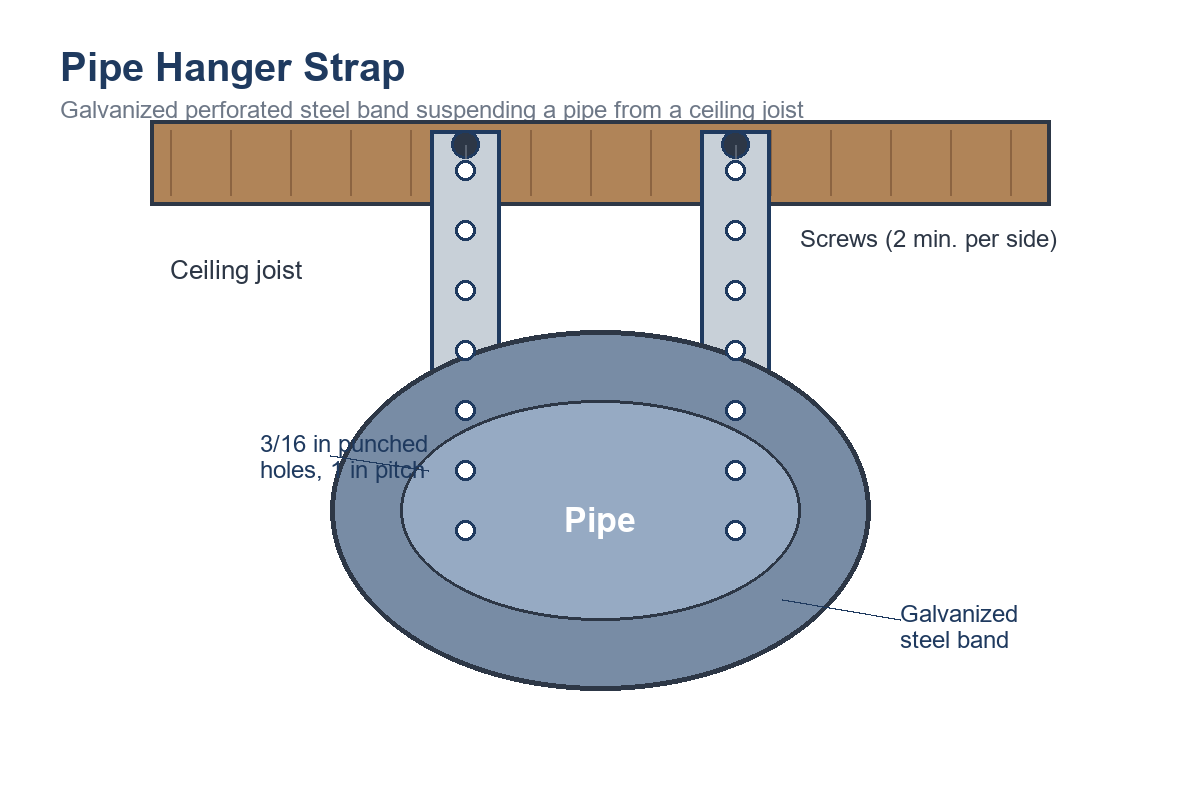
A pipe hanger strap — also called plumber’s strap, pipe strap, or suspension strap — is a continuous galvanized steel band with punched holes along its length. The holes let screws or nails pass through at any point, so the strap can be cut to the exact length needed on site and wrapped around any pipe diameter. The zinc coating protects the steel in damp mechanical rooms and crawl spaces, and the steel itself keeps tension for decades where plastic alternatives stretch and sag. It is sold in rolls and coils under several trade names — including band iron and hanger band — but the product is the same. We manufacture these straps at our Jiangmen facility, and the specifications below are the ones that actually decide whether an installation stays level for twenty years.
Pipe Hanger Strap Sizes and Specifications
The standard product is more standardized than most buyers realize:
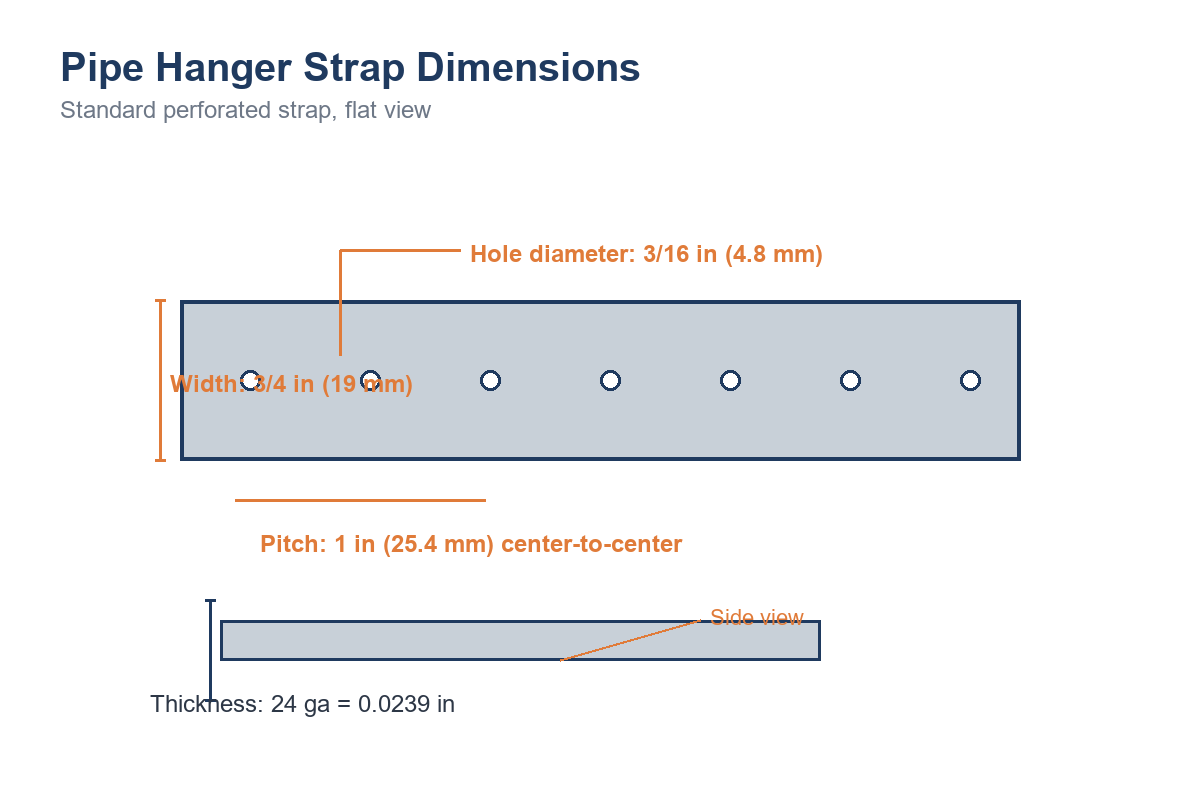
- Width: 1/2 in, 3/4 in (the workhorse), and 1 in. The 3/4 in size covers most residential and commercial pipe support.
- Thickness (gauge): 28 gauge (0.015 in / 0.38 mm), 26 gauge (0.018 in), 24 gauge (0.0239 in), and 22 gauge (0.0299 in). Our 28 vs 24 gauge comparison explains when each is the right call.
- Hole pattern: 3/16 in diameter holes on 1 in centers is the common pattern; 1/4 in holes on 2 in centers are used for heavier fasteners.
- Coating: zinc per ASTM A653 — G30, G60, or G90, equivalent to 0.30, 0.60, and 0.90 oz/ft² of zinc on both sides combined.
- Edge type: straight or wavy; the wavy edge grips round pipe more firmly.
Full dimensional tables are on our specification page.
How Much Weight Can One Strap Hold?
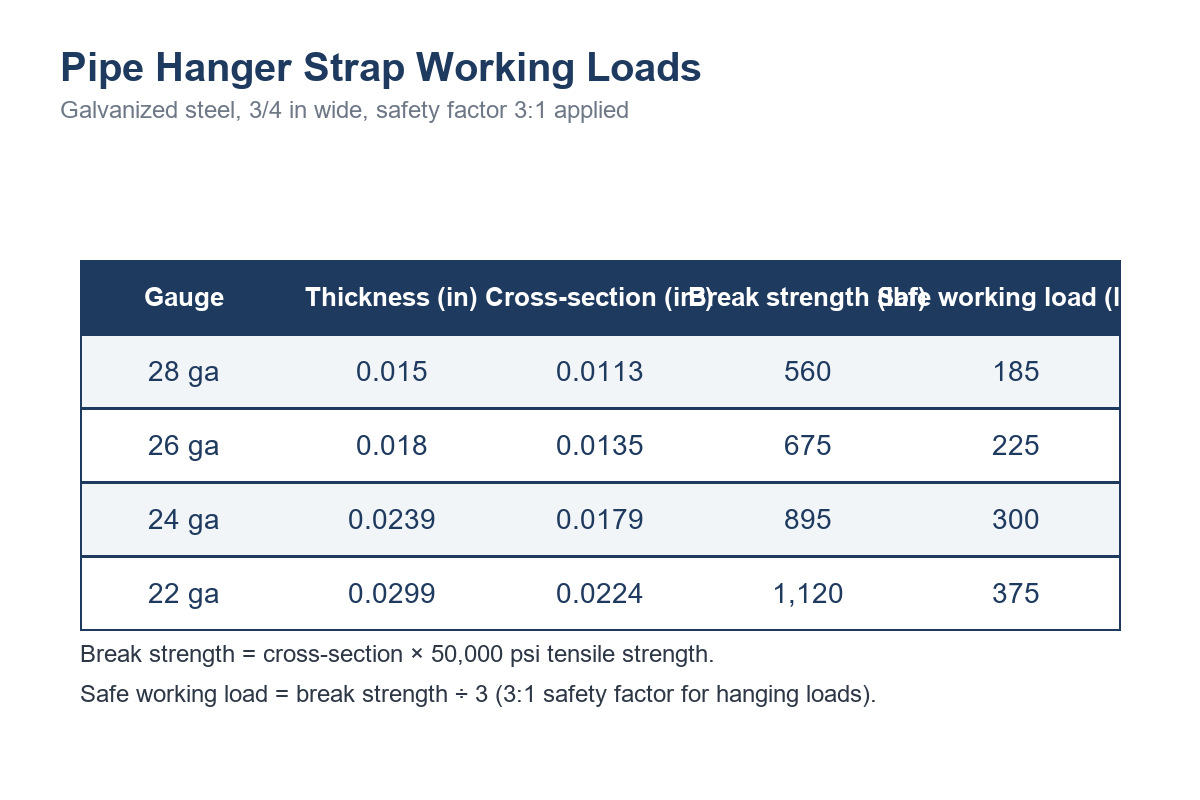
The number comes from a simple calculation: break strength equals the cross-sectional area of the steel times its tensile strength, roughly 50,000 psi for regular-duty galvanized strap. A 3/4 in × 24 gauge strap has about 0.0179 in² of cross-section, so it breaks around 895 lbf. Apply a 3:1 safety factor for a hanging load and the safe working load is about 300 lbf. In practice the fastener joint carries only 70–80% of the strap’s full strength, so the screws and washers deserve as much attention as the gauge. For a deeper dive into real-world capacity, see how strong is perforated hanger strap.
How to Install a Pipe Hanger Strap
- Cut the strap with a dedicated strap cutter or sharp aviation snips; deburr the cut end so it cannot nick hands or wiring.
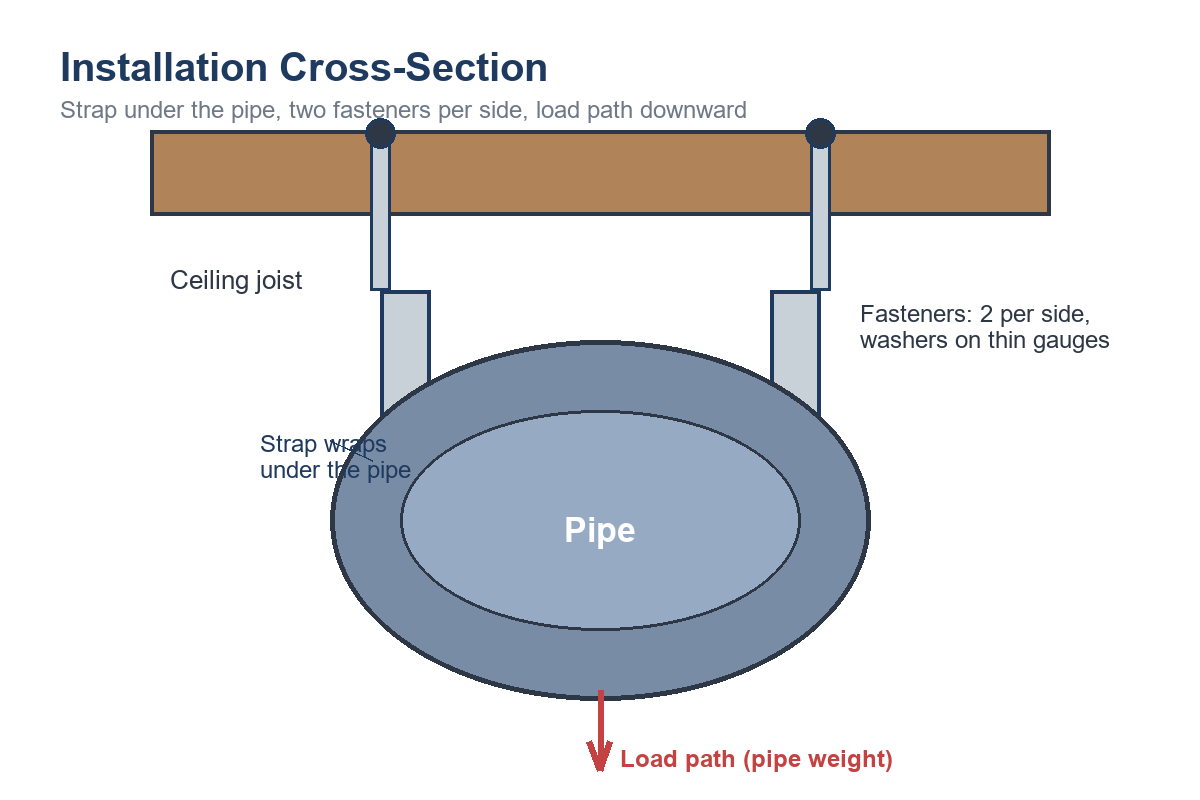
- Wrap the strap under the pipe and run both ends up to the support. Use at least two fasteners per side; washers are recommended on 26 gauge and thinner.
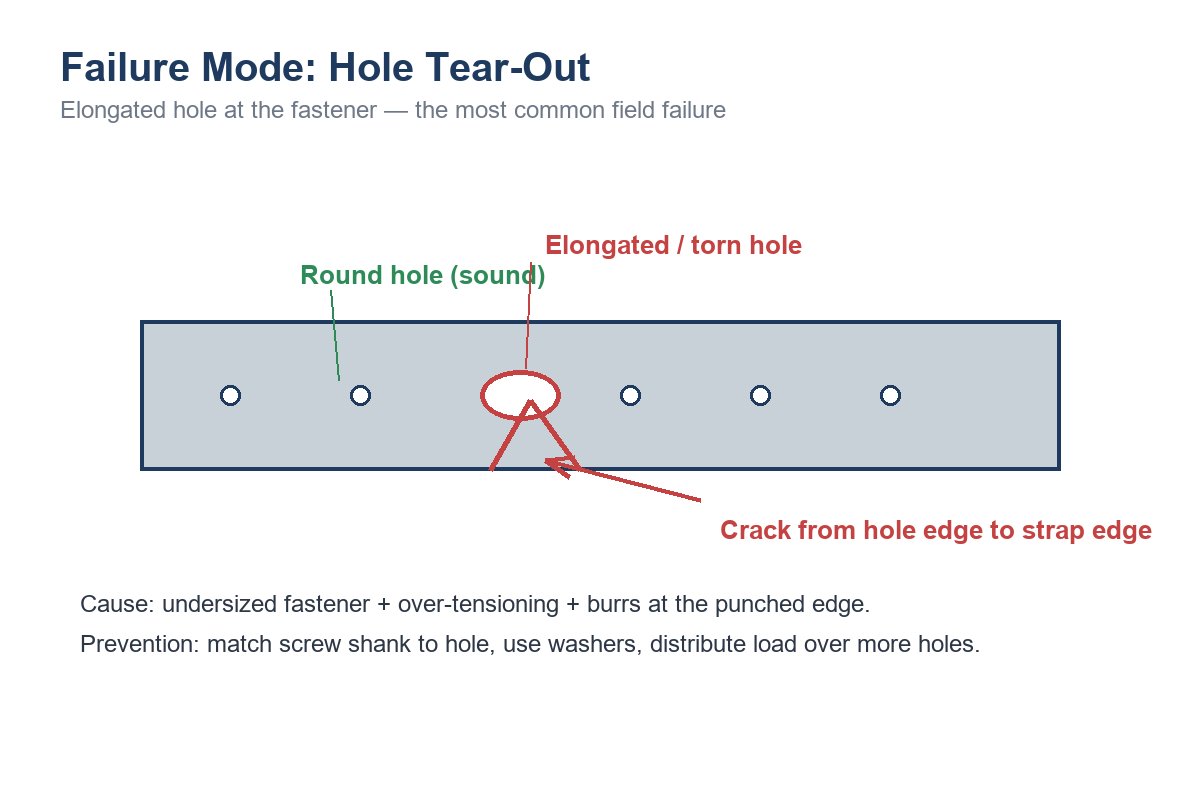
- Match the screw shank to the hole diameter — an undersized fastener concentrates stress and promotes hole tear-out.
- Snug the strap to the pipe without crushing it; on copper, allow for thermal movement by leaving a hair of clearance rather than clamping hard.
- Touch up cut ends with zinc-rich paint in wet environments.
- Before fastening, confirm the hole pitch lines up with your support spacing so every screw lands in an existing hole — the 1 in pitch works for any spacing in whole inches.
Pipe Hanger Strap vs. Clevis Hanger vs. Ring Hanger
- Strap: the cheapest and most flexible option; cut to length, fits any pipe size, ideal for light to medium lines, conduit, and cable tray.
- Clevis hanger: a rigid U-shaped bracket for a specific pipe trade size; better for insulated lines and where height adjustment matters, but costs more and must be ordered per size.
- Ring hanger: a closed loop typically fixed to a threaded rod; solid support for single lines, but the pipe must be threaded through it at installation.
Distributors and installers usually stock all three: strap for speed and flexibility, clevis for engineered jobs, and ring hangers for rod-suspended runs. On plumbing projects, strap is the default for DWV and domestic water lines — see hanger strap for plumbing support for typical installations, and our galvanized pipe strap buying guide for selection criteria. As a rule of thumb for specification: if the line is insulated, moves with thermal cycling, or must be individually engineered, move up from strap to clevis or ring hardware; for everything else, strap is the fastest and most economical suspension method on the market.
Common Failure Modes and How to Avoid Them
- Hole tear-out: the load concentrates at the fastener hole and the steel tears toward the edge — the most common field failure. Use the largest fastener that fits, add washers, and spread the load across more holes.
- Corrosion at cut ends: every site cut exposes bare steel. Touch up with zinc-rich paint or specify stainless for wet locations.
- Over-tightening: thin gauges crush under screw heads and loosen over time. Stop at snug plus a quarter turn.
- Vibration cracking: nicks left by dull snips become crack starters. Cut clean and deburr.
FAQ
- What gauge should I use? 28 gauge for light lines and conduit, 24 gauge for standard plumbing and HVAC, 22 gauge for heavier suspended loads.
- Is pipe hanger strap the same as plumber’s strap? Yes — pipe hanger strap, plumber’s strap, and pipe strap are the same product under different trade names.
- Does it rust? Galvanized strap resists rust for years in dry conditions; G90 or stainless steel is the choice for wet, coastal, or chemical exposure.
- Can it be used outdoors? With G90 coating or stainless steel, yes; G30 is for dry indoor use only.
- What screw size fits the standard holes? A #8 or #10 pan-head screw fits the 3/16 in holes well; match the shank to the hole to avoid slop and tear-out, and add washers on 26 gauge or thinner.
Key Takeaways
- A pipe hanger strap is a perforated galvanized steel band, standard 3/4 in wide, 24–28 gauge, with 3/16 in holes on 1 in centers.
- Safe working load runs roughly 185–375 lbf per strap depending on gauge, with a 3:1 safety factor.
- Two fasteners per side, matched shank diameter, and deburred cuts prevent the four common failure modes.
- Choose the gauge by load, the coating by environment — G30 dry indoor, G60 general, G90 or stainless for wet or outdoor.
Conclusion
The strap looks like the simplest product in the catalog, and it is — until it is specified by guesswork. Choose the gauge from the load table, match fasteners to holes, protect cut ends, and this twenty-cent strap will outlast the pipe it carries. For product details and ordering, see our perforated hanger strap page, download product catalogs, or reach us through the contact page. The governing standard for the steel substrate is ASTM A653.