
What Is Steel Strapping?
Steel strapping is a high-strength flat band of cold-rolled steel used to bundle, unitize, hang, or reinforce loads in packaging, construction, and industrial applications. It comes in coils and is cut to length on site, then secured with seals, buckles, or screws. Unlike rope or plastic ties, steel strapping maintains its tension over time, resists cutting and abrasion, and carries predictable, documented tensile strength — which is why it remains the standard for loads that are heavy, sharp-edged, or exposed to heat.
At Jiangmen Masters Hardware, we have manufactured steel strapping for over 16 years, producing everything from perforated hanger straps with punched holes to heavy banding iron for industrial packing. This guide covers the types, specifications, and field-tested selection criteria we advise our customers to use before every order.
Types of Steel Strapping
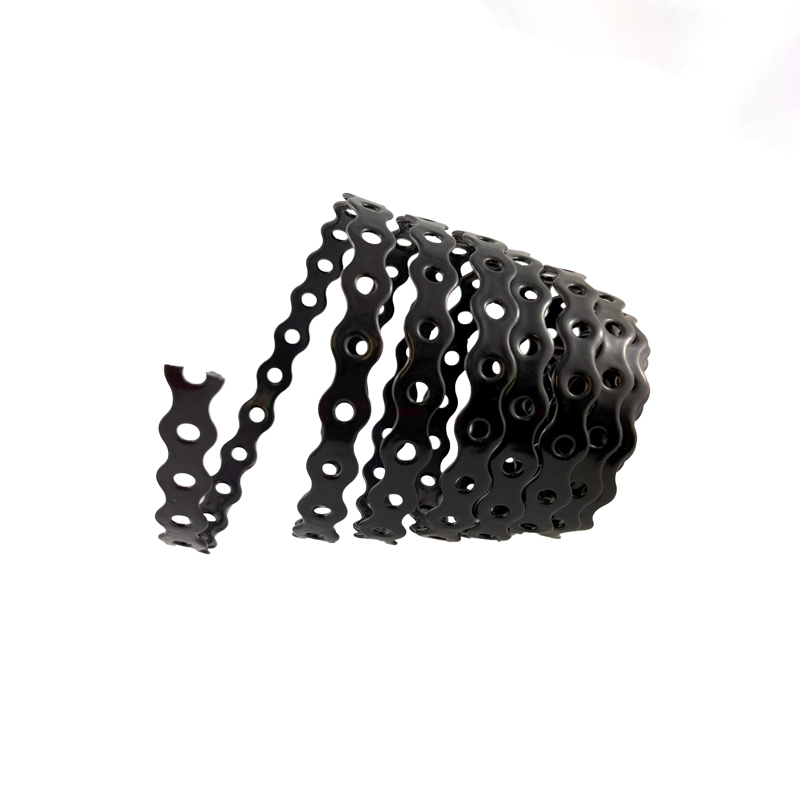
Steel strapping is not one product. The right type depends on what it must hold and where it will live:
- Regular-duty (cold-rolled): lower carbon content, tensile strength around 45,000–55,000 psi (310–380 MPa), and high elongation of 20–30%. It bends without breaking and is ideal for hanger straps and applications that require wrapping or on-site forming.
- High-tensile: heat-treated to 100,000 psi (690 MPa) and above, with low elongation of 5–12%. Used for heavy bundles, coils, and palletized loads where maximum retention with minimum stretch is required.
- Galvanized: zinc-coated for corrosion resistance. Coating weight is specified as G30, G60, or G90 under ASTM A653, expressed in ounces of zinc per square foot of total surface area.
- Stainless steel: grades 304 and 316 (ASTM A240) for coastal, chemical, and food-grade environments. See our galvanized vs. stainless steel strapping comparison.
- Copper-plated or painted: for appearance, conductivity, or color coding — see our copper hanger strap page.
Beyond material, strapping is available with or without punched holes, and with a straight edge or a wavy edge. The wavy edge grips round surfaces such as pipe and duct more firmly, while the straight edge sits flat against rigid packages.
How Steel Strapping Is Made
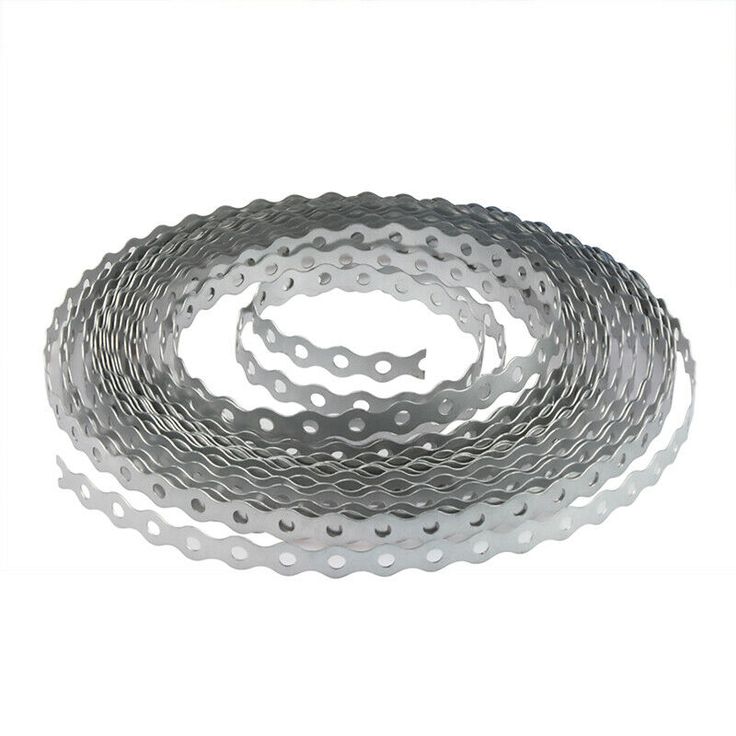
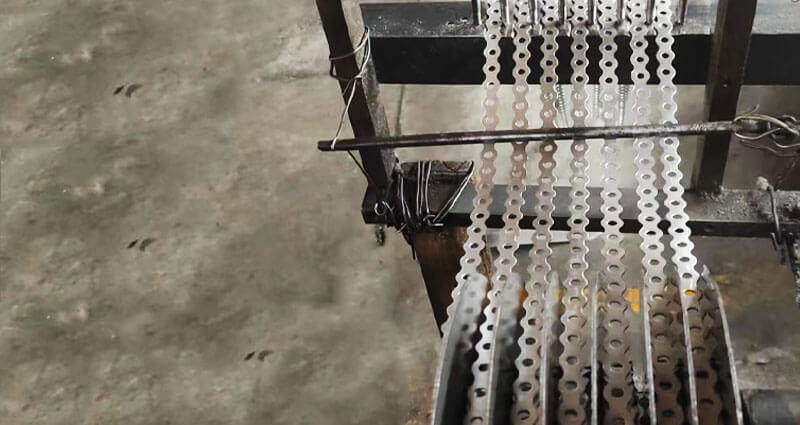
Quality starts with the strip. We slit cold-rolled steel coils to precise widths, then apply the finish: hot-dip or electrolytic galvanizing for corrosion protection, or heat treatment for high-tensile grades. Perforated products pass through progressive-die punching lines where hole diameter is held within ±0.005 in and pitch stays consistent from the first hole to the last. Edges are conditioned straight or wavy, deburred to remove stress-raising burrs, and the finished band is wound into oscillated or ribbon-wound coils sized to the customer’s packaging line.
Each of these steps matters in service. A burr left at a punched hole or cut edge is a crack initiation point. Uneven galvanizing means premature rust. This is why we run 100% inspection on finished coils rather than sampling.
Key Specifications and What They Mean
When comparing quotations, these are the numbers that determine performance:
- Width: from 1/2 in to 1-1/4 in for hanger straps; up to 2 in and beyond for industrial banding.
- Thickness (gauge): 28 gauge (0.015 in / 0.38 mm) up to 20 gauge (0.036 in / 0.91 mm) for hanger straps. Industrial banding runs 0.020–0.050 in.
- Tensile strength: the ultimate load per unit area before break — roughly 50,000 psi for regular duty, 100,000+ psi for high-tensile.
- Yield strength: the stress at which permanent deformation begins; typically around 30,000 psi (205 MPa) for regular-duty galvanized strap.
- Elongation: regular duty stretches 20–30% before breaking, high-tensile only 5–12%. More elongation means more shock absorption but less stiffness.
- Break strength: tensile strength multiplied by cross-sectional area, the number to use when sizing. A 1/2 in × 28 gauge regular-duty strap has about 0.0075 in² of cross-section, giving a break strength near 375 lbf.
- Hole pattern: for perforated strap, common diameters are 3/16 in (4.8 mm) and 1/4 in (6.4 mm) on 1 in or 2 in centers. Full dimensional tables are on our specification page.
- Coil format: oscillated coils feed automated lines without tangling; ribbon-wound coils are the economical choice for manual tools.
Always apply a safety factor to break strength — we recommend at least 3:1 for hanging loads, because the seal or fastener joint typically carries only 70–80% of the strap’s full strength. For capacity details, read how strong is perforated hanger strap.
Common Applications
Steel strapping appears in nearly every industry that moves or supports material:
- Packaging and logistics: bundling lumber, bricks, pipe, and metal profiles; unitizing pallets; securing coils and rolls for transport.
- Construction: hanger straps for suspended ceilings, framing ties, and temporary bracing.
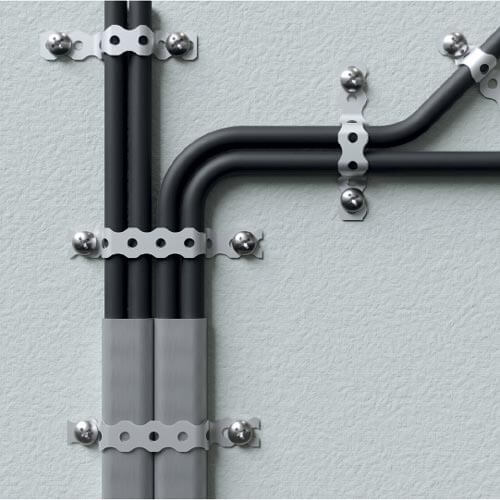
- HVAC: suspending ductwork and units with perforated galvanized hanger strap cut to length on site.
- Plumbing and electrical: supporting pipes, conduit, and cable trays, often combined with saddle clamps and fixing bands.
- Automotive and appliance: securing exhaust systems, wiring harnesses, and shipping protection.
Steel Strapping vs. PET Strapping
Polyester strapping has replaced steel in many light-duty packaging lines, but the two are not interchangeable. PET is rust-proof, safer to handle, and cheaper per meter, yet it stretches under sustained load and loses tension over time — a serious problem on heavy or sharp-edged loads. Steel keeps tension indefinitely, survives contact with metal edges that would cut PET, and performs at temperatures that soften plastic. The practical rule we give customers: if the load weighs more than 400–500 kg, has sharp edges, or will sit in storage for months, use steel.
Field Experience: Where Steel Strapping Fails
In sixteen years of production and thousands of customer feedback reports, failures concentrate in four places:
- The seal or fastener joint: the joint is always the weakest link. Use seals sized to the strap, crimp correctly, and never place the seal on a corner.
- Notch damage: cutting straps with dull snips or crimping tools that nick the band creates stress risers. High-tensile strapping is especially sensitive to edge nicks.
- Corrosion at cut ends: galvanizing protects the surface, but every site cut exposes raw steel. In wet environments, touch up cut ends with zinc-rich paint or specify stainless.
- Over-tensioning perforated strap: punching removes metal and concentrates stress at the holes. Tension beyond the design limit tears the strap hole-to-hole, a failure we see often on improvised installations.
How to Choose and Order the Right Steel Strapping
Work through four questions. First, environment: indoor dry conditions allow standard galvanized strap; coastal, chemical, or washdown areas call for stainless steel. Second, load: calculate the break strength you need, apply a 3:1 safety factor for hanging or a 1.5:1 factor for bundling, and select width and thickness accordingly. Third, fastening: for perforated strap, confirm the hole pitch matches your support spacing so no extra drilling is needed on site. Fourth, documentation: a qualified supplier provides mill test reports with tensile and yield data, zinc coating weight certificates, salt-spray test hours, and RoHS compliance — ask for all of them, and sample the product before committing to volume. Most manufacturers, including ours, support custom widths, thicknesses, hole patterns, edge forms, and coil lengths, so there is rarely a reason to compromise on a stock size. Download our product catalogs or request samples via the contact page.
Conclusion
Steel strapping earns its place through strength, tension retention, and documented mechanical properties that no plastic alternative matches on heavy loads. The difference between a strapping job that holds for years and one that fails in transit is rarely the steel itself — it is the specification. Choose the right grade, size the strap to the load with a real safety factor, protect the joint, and your strapping will do exactly what the numbers promise. See our metal strap with holes guide for the perforated variant.